The New TARC Network is here!
The New TARC Network arrived Sunday, August 2, 2026. It brings major changes for most TARC riders with new routes, route numbers, schedules and bus stops. TARC is here to help you navigate the changes.
The New TARC Network provides faster, more reliable bus service for most TARC riders with more frequent service on major corridors across the city. Buses run every 15 minutes all day on Broadway, Bardstown, Preston, 4th Street, Dixie Highway and Market Street, and a new Downtown Transfer Center makes it easier to connect between routes.
Explore below to learn more about the New TARC Network!
- New TARC Network Comparative Trip Planner
- New TARC Network System Map
- New TARC Network Downtown Map
- New Route Maps and Schedules
- New Bus Stop Signs
- Note: TARC will begin replacing its old signs with the new signs starting in May, however, all existing TARC stops will continue to be served through August 1
- Compare your routes
- Bus Stop Changes in the New TARC Network
- JCPS Changes in the New TARC Network
- Downtown Transfer Center
- Frequently Asked Questions (FAQs)
- Archival material on TARC 2025
New TARC Network Comparative Trip Planner
The New TARC Network Comparative Trip Planner below helps riders learn their new routes and stops so that they can plan their travels in the New TARC Network. Enter your trip information below and click the triangle icon to see how you will be able to use the New TARC Network to get around Louisville.
Use caution–walking directions may not always reflect real-world conditions
New TARC Network is active network beginning August 2, 2026. You can continue to use trip planning tools such as Transit App and Google Maps.
New TARC Network System Map
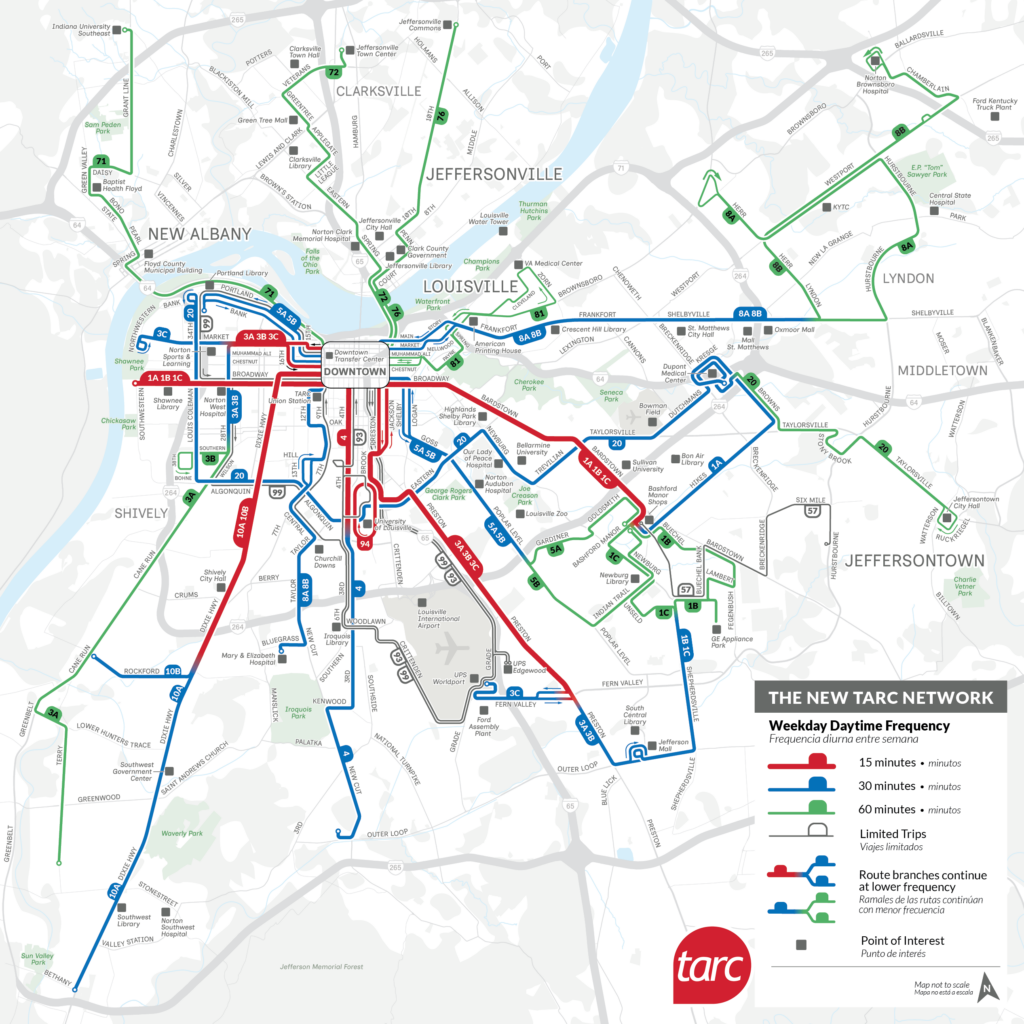
To view a larger version of this map, please click here.
Written descriptions of each route in the New TARC Network can be found here.
New TARC Network Downtown Map
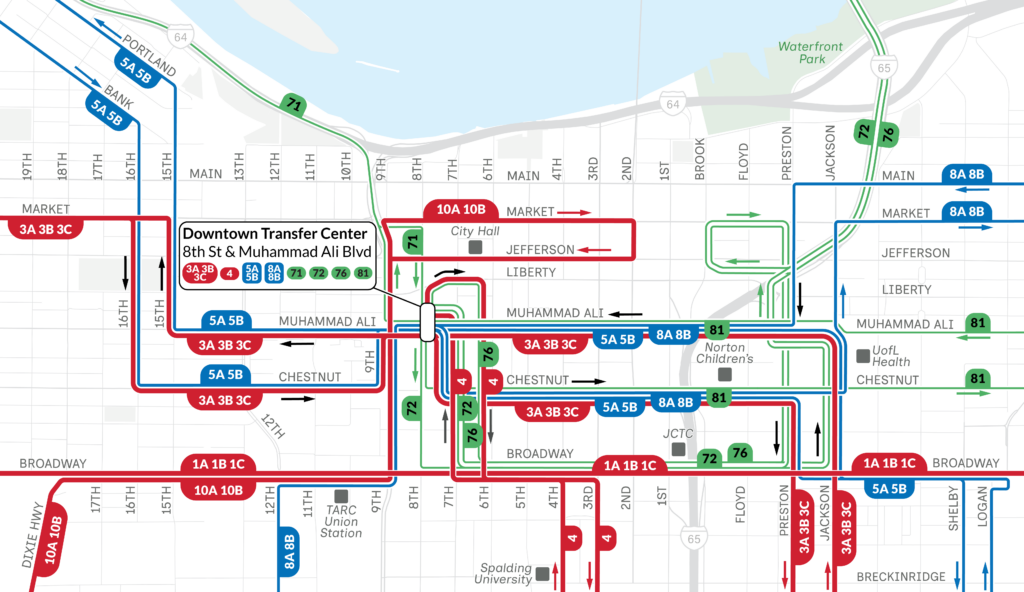
To view a larger version of this map, please click here.
New Route Maps and Schedules
Effective August 2, 2026
Route #1: Broadway – Bardstown
How often: Every 15 minutes on weekdays
CLICK HERE TO VIEW THE ROUTE #1 MAP AND SCHEDULE
Key Destinations
- Shawnee Park
- West Louisville
- Downtown
- Highlands
- Bardstown Road
- Bashford Manor Mall
- Hikes Lane
- Dutchmans Lane
- Buechel/GE
- Newburg/Unsled
- Shepherdsville Road
- Jefferson Mall
Route #3 Preston Highway – West Market
How often: Every 15 minutes on weekdays
CLICK HERE TO VIEW THE ROUTE #3 MAP AND SCHEDULE
Key Destinations
- Pleasure Ridge Park
- Shively
- Park DuValle
- Parkland
- Shawnee Park
- West Louisville
- Downtown
- Medical District
- University of Louisville
- Preston Highway
- UPS Worldport
- Jefferson Mall
Header text
Route #4 Fourth Street – New Cut
How often: Every 15 minutes on weekdays
CLICK HERE TO VIEW THE ROUTE #4 MAP AND SCHEDULE
Key Destinations
- Downtown
- Broadway
- Old Louisville
- University of Louisville
- Churchill Downs
- Beechmont
- Southside
- Iroquois
- Kenwood
- Auburndale
- Outer Loop
Route #5 Portland – Poplar Level
How often: Every 30 minutes
CLICK HERE TO VIEW THE ROUTE #5 MAP AND SCHEDULE
Key Destinations
- Portland
- Downtown
- Broadway
- Shelby Park
- Germantown
- Poplar Level
- Gardiner Lane
- Goldsmith Lane
- Watterson Park
- Newburg
- Bashford Manor Mall
Route #8 Shelbyville Road – Taylor Boulevard
How often: Every 30 minutes
CLICK HERE TO VIEW THE ROUTE #8 MAP AND SCHEDULE
Key Destinations
- Mary & Elizabeth Hospital
- Park Hill
- Downtown
- Clifton
- Crescent Hill
- St. Matthews
- Ormsby Station
- Lyndon Lane
- Westport Road
- Holiday Manor
- Norton Hospital
Route #10 Dixie Highway
How often: Every 15 minutes on weekdays
CLICK HERE TO VIEW THE ROUTE #10 MAP AND SCHEDULE
Key Destinations
- Downtown
- Broadway
- California
- Park Hill
- Algonquin
- Shively
- Rockford Lane
- Hunters Trace
- Pleasure Ridge Park
- Valley Station
Route #20 Eastern Parkway
How often: Every 30 minutes
CLICK HERE TO VIEW THE ROUTE #20 MAP AND SCHEDULE
Key Destinations
- Portland
- West Louisville
- Broadway
- Park DuValle
- Algonquin
- University of Louisville
- Eastern Parkway
- Belknap
- Taylorsville Road
- Dutchmans Lane
- Hikes Point
- Jeffersontown
Route #57 Buechel Circulator
How often: Limited trip service
CLICK HERE TO VIEW THE ROUTE #57 MAP AND SCHEDULE
Key Destinations
- Bashford Manor Mall
- GE Gate 3
- Buechel Bank Road
- Bardstown Road
- Breckenridge Lane
- Breckenridge Plaza
- Six Mile Lane
- Hurstbourne Meijer
Route #71 New Albany – IUS
How often: Every 60 minutes
CLICK HERE TO VIEW THE ROUTE #71 MAP AND SCHEDULE
Key Destinations
- Downtown Louisville
- Downtown New Albany
- Bono Road
- Baptist Health Floyd
- Daisy Lane
- Grant Line Road
- Indiana University Southeast
Route #72 Clarksville
How often: Every 60 minutes
CLICK HERE TO VIEW THE ROUTE #72 MAP AND SCHEDULE
Key Destinations
- Downtown Louisville
- Broadway
- Downtown Jeffersonville
- Downtown Clarksville
- Little League Park
- Green Tree Mall
- Jeffersonville Town Center
Route #76 Jeffersonville
How often: Every 60 minutes
CLICK HERE TO VIEW THE ROUTE #76 MAP AND SCHEDULE
Key Destinations
- Downtown Louisville
- Broadway
- Downtown Jeffersonville
- Court Street
- U.S. Census Bureau
- 10th Street
- Jefferson Commons
Route #81 Downtown – Zorn
How often: Every 60 minutes
CLICK HERE TO VIEW THE ROUTE #81 MAP AND SCHEDULE
Key Destinations
- Downtown
- Phoenix Hill
- Irish Hill
- Butchertown
- Clifton
- Zorn Avenue
- VA Hospital
Route #94 Cardinal Shuttle
How often: Every 6 to 10 minutes only on weekdays
CLICK HERE TO VIEW THE ROUTE #94 MAP AND SCHEDULE
Key Destinations
- Cardinal Stadium
- Central Avenue
- Brook Street
- Engineering Graphics
- Eastern Parkway
- Ekstrom Library
- Brandeis Avenue
- Cardinal Boulevard
- Student Activity Center
- University Boulevard
- Hahn Street
Route #93 UPS UofL Shuttle, #99 UPS West Louisville Shuttle
How often: Limited trips only
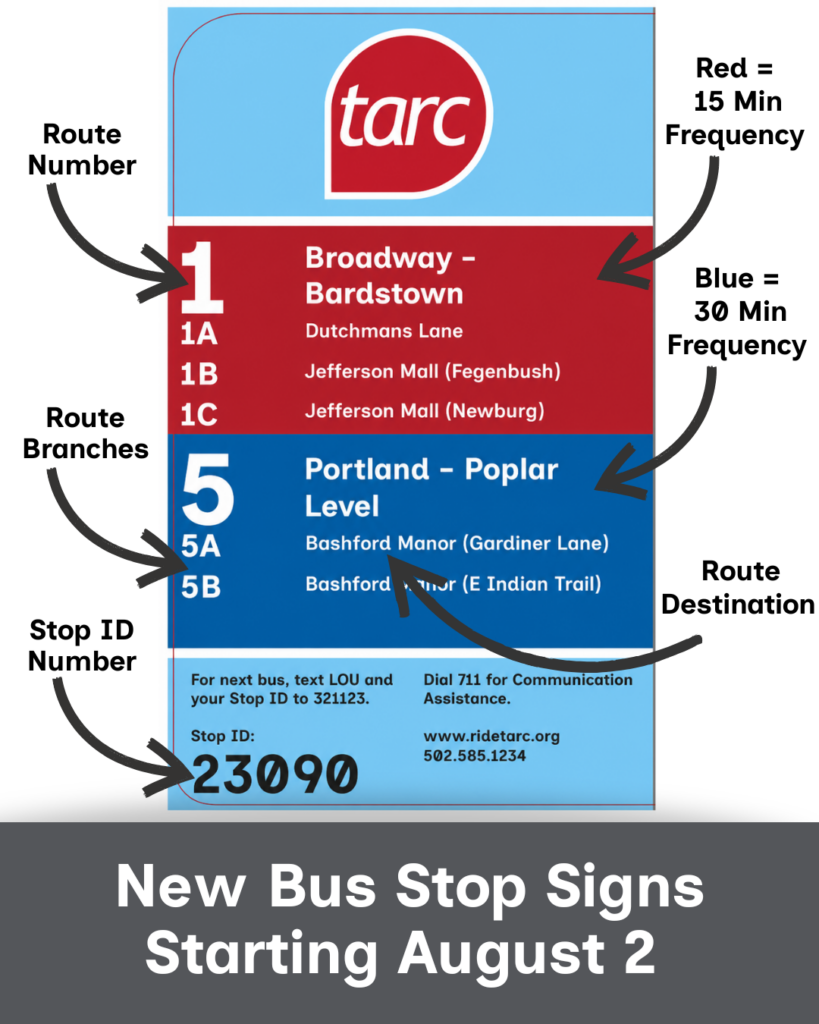
New Bus Stop Signs
One exciting feature of the New TARC Network is new bus stop signs! These new signs are larger, and double-sided so passengers can see them no matter the direction they approach the bus stop. Each sign includes:
Route Number & Name: The route number will be the main identifier you use for your route, while the route name is typically the primary corridor(s) it serves.
Route Branches (ex. 1A, 1B, 1C): The new network includes route branching where a single route splits to serve multiple corridors. For these routes, letters are used to identify the different branches so riders can make sure they are on the right bus.
Route Destination: Where is this route or bus heading? What direction does it go?
Color-Coding by Route Frequency: Each route has a color to tell you how often it runs on weekdays (Red = 15 minutes, Blue = 30 minutes, Green = 60 minutes).
Stop ID Number: You can text the Stop ID included on the bus stop sign to 321123 to receive information on your next bus stop arrival
Note: TARC will begin replacing its old signs with the new signs starting in May, however, all existing TARC stops will continue to be served through August 1
Compare your routes
Several of our new bus routes have different numbers but continue to travel along the same streets as our current routes, so most riders will still have access to local bus service.
Use this chart to see what routes you could ride in the new network.
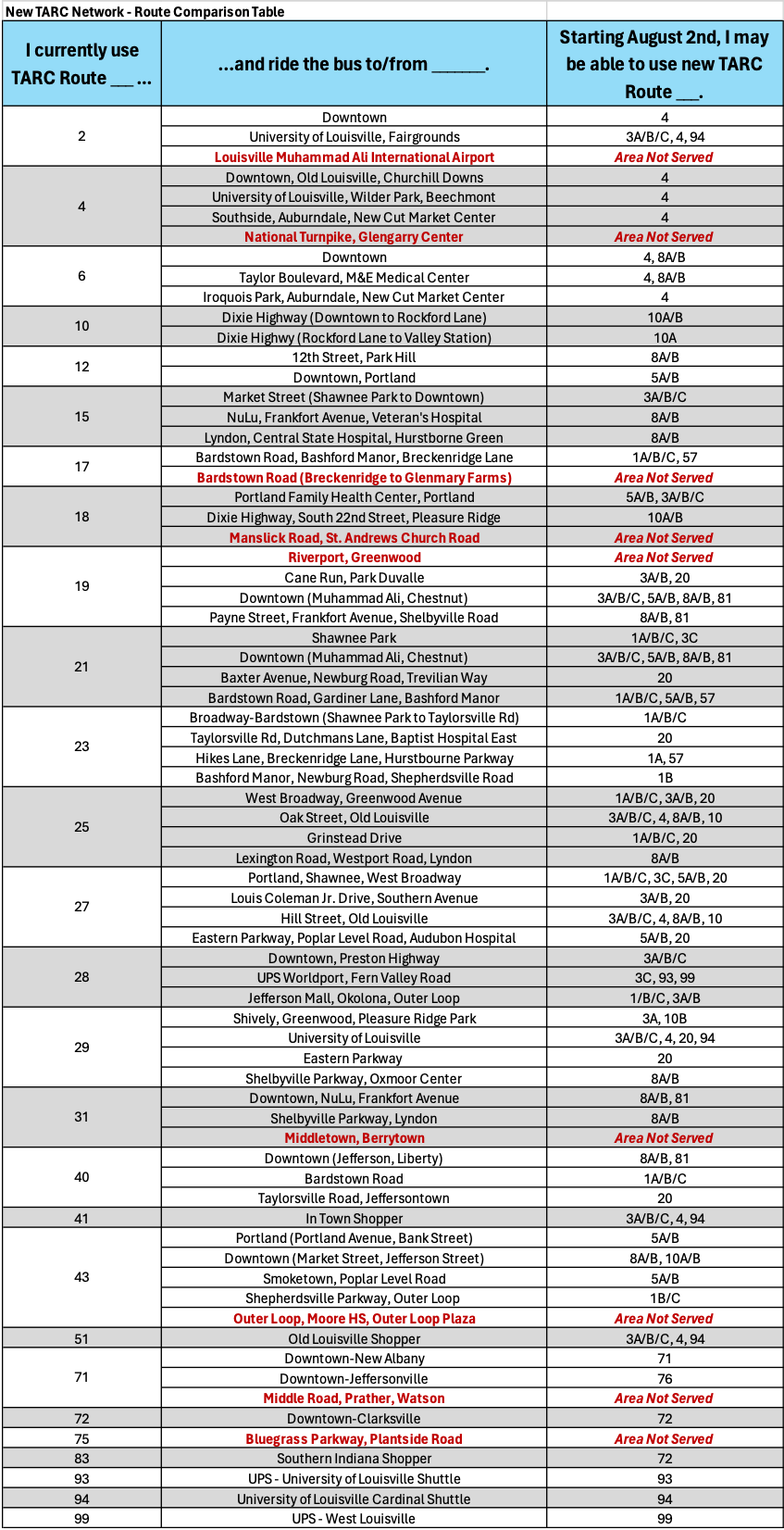
Click here to view a PDF of this chart.
Bus Stop Changes in the New TARC Network
As part of the New TARC Network project, TARC has re-evaluated each of its 3,000+ bus stops to determine which stops will be included in the new network and which stops will be consolidated or eliminated to help make bus service faster and more direct.
JCPS Changes in the New TARC Network
TARC worked diligently to maintain as much TARC service as possible to JCPS high schools in the New TARC Network. As a result, the New TARC Network continues to serve all ten (10) JCPS magnet high schools and most other JCPS high schools and middle schools. JCPS high schools that were previously served by TARC buses but will not be served after the New TARC Network launches on August 2, 2026 include Doss High School, Eastern High School, Fern Creek High School, Moore High School, and Southern High School.
TARC previously identified a plan that would maintain TARC bus service to all high schools, but it would require significant additional funding that is not currently available.
Downtown Transfer Center
The New TARC Network features a new, temporary Downtown Transfer Center at the corner of Muhammad Ali Boulevard and 8th Street with on-street bus bays, shelters, and customer wayfinding information.
Frequently Asked Questions (FAQs)
What is the New TARC Network?
The New TARC Network includes new routes, route numbers, schedules, bus stops and bus stop signs. All TARC riders will need to learn about the new network before it is launched on August 2, 2026.
When will TARC’s new routes begin?
The New TARC Network began on Sunday, August 2, 2026. TARC offered fare-free rides for all customers for the first two weeks from August 2-16 to encourage community members to try out the new network.
Why is TARC changing?
Existing local and state dollars for transit are not enough to pay for current levels of service so TARC has had to find ways to be more efficient while still meeting the needs of the Louisville community.
In June of 2024 TARC began working directly with the community to design an updated transit network that aligns with Louisville’s priorities and needs while reflecting the agency’s available funding. TARC presented options and gathered feedback from over 300 community meetings, and workshops; the New TARC Network is the result of that process.
Although the New TARC Network requires less funding, it will create a bus network that is more useful and dependable for many residents across the Louisville region. It includes simpler routes, more frequent 15-minute service on major corridors, and a new Downtown Transfer Center to make transfers easier and more convenient.
Will I have a new bus route number?
Most bus routes in the New TARC Network will have new route numbers. The new route numbers will help riders understand that their route is changing and may not go to the same places it went before.
The new route numbers will also help to make the system easier to understand and use. Routes with lower numbers (e.g. 1, 3, 4, 5, 8, 10) are the core routes that connect to Downtown Louisville with frequent service running every 15-30 minutes seven days per week. These routes are usually more direct and are more convenient to use. Routes with higher numbers (e.g. 20, 57, 81, 93) operate with less frequent or specialized service and may not run on weekends.
Some routes will also have letters, like Routes 8A and 8B. The letters indicate routes that branch to provide service on multiple corridors. On these routes, the trips will alternate (e.g. 8A, 8B, 8A, 8B) so that every other trip will follow the A alignment and every other trip will follow the B alignment. If you are using a route that has a letter on it, make sure you know which specific letter branch(es) you can use to get to your destination.
To identify your new route(s), use the comparative trip planner to plan a trip, or use the New TARC Network Route Comparison Table.
Where can I find the schedule for my new route?
New TARC Network route maps and schedules can be found above.
Which TARC routes are going away?
Most TARC routes will have new route numbers, but some of the new routes will be very similar to existing routes. For example, the new Route 1 will be very similar to the existing Route 23.
While most riders will continue to have access to TARC service, some areas will no longer be served due to low ridership. Areas that will no longer be served after August 1, 2026 include:
- National Turnpike
- Glengarry Center
- Bardstown Road (east of Breckenridge)
- Manslick Road
- St. Andrews Church Road
- Riverport
- Greenwood
- Louisville International Airport
- Middletown (Taylorsville Road will be served by Route 20)
- Berrytown
- Plantside Drive, Bluegrass Parkway (Jeffersontown)
- Outer Loop (east of Shepherdsville Parkway)
- Middle Road, Centennial Boulevard (Jeffersonville)
- 10th Street North (north of Jeffersonville Commons)
TARC riders in these areas may be able to use alternate routes in the new network. Please use the NTN Trip Planner to enter your specific trip details to determine whether your trip will be possible in the New TARC Network.
Any additional feedback or questions about the route changes should be directed to the TARC Customer Service Department. All feedback will be provided to the TARC Planning Department and TARC Leadership for consideration as part of future service adjustments.
Will my bus stop be changing or going away?
Many bus stops will be changing or removed in the New TARC Network due to route alignment changes and stop consolidations. On many streets, the current TARC network has a bus stop on every block, which means the bus must stop more often, it takes people longer to get where they want to go, and the service is less reliable. By rebalancing the stops so buses only need to stop once every 2-3 blocks, the service TARC provides will be more convenient and reliable. Fewer stops will also make it easier for TARC to provide bus stop amenities like shelters, benches, and trash cans since fewer of installations are needed. This allows us to invest more in the places where the riders use the system the most.
Notices will be posted at any bus stops that are subject to removal. No existing TARC bus stops will be removed prior to August 2, 2026.
A full list of bus stop changes can be found here.
TARC will also be using the New TARC Network as an opportunity to improve accessibility and amenities at many of its bus stops. All new bus stops will be fully ADA compliant and TARC will be working to update existing stops to make them more accessible. Additionally, TARC will be relocating shelter and benches from discontinued bus stops to bus stops served by the new network beginning in the fall.
What happens if my route or stop has been eliminated?
While the New TARC Network seeks to provide an overall benefit for the Louisville community, it will have a negative impact on a small number of riders who are no longer be within ½ mile of a TARC bus stop.
Riders who no longer have access to TARC service within ½ mile in the new network may be able to walk or bike further than ½ mile to reach the nearest TARC route. Riders with limited mobility may be eligible for TARC 3 paratransit service (https://ridetarc.org/getting-around/tarc3/).
Additional information on the planning process and the factors that shaped service decisions can be found on the TARC 2025 project page. Customers who would like to provide feedback on the New TARC Network should contact the TARC Customer Service Department so that their feedback can be considered as part of future service planning processes.
What is the Downtown Transfer Center?
The New TARC Network includes a temporary Downtown Transfer Center at the corner of Muhammad Ali Boulevard and 8th Street, featuring on-street bus bays, shelters, and customer wayfinding information.
The purpose of the Downtown Transfer Center is to provide a central location where all the different buses serving downtown can come together in a scheduled “pulse” that will allow passengers to transfer between routes in 5-10 minutes. By providing a comfortable, convenient Downtown Transfer Center with timed transfers, TARC customers are able to travel across the Louisville region, even with routes that only run every 30 or 60 minutes. Work to establish the temporary Downtown Transfer Center will be completed by Summer 2026, and it is expected to remain in use until a permanent Downtown Transfer Center is constructed in the future.
More information about the new Downtown Transfer Center can be found here.
How is frequency increasing in the New TARC Network?
The New TARC Network includes fewer, simpler routes with better frequency (i.e. more trips) for more reliable TARC service. The number of TARC routes with frequent service running every 15 minutes or better will increase from three routes in the current TARC Network (23, 28, 94) to five routes in the New TARC Network (1, 3, 4, 10, 94). As a result of these new routes, the new network will provide frequent service to 35,000 additional residents in Louisville and the number of jobs near frequent service will increase by 5%.
Service frequencies will also be more consistent with most routes running every 30 or 60 minutes. The current TARC network includes many routes that run every 40, 45 or 80 minutes which are harder to remember, less useful, and make timed transfers nearly impossible to coordinate.
Why are there so many colors? What do they mean?
The key to the New TARC Network is frequency, — how often a bus arrives on each route. Colors like red, blue and green are used to communicate how often each route will be running. Routes that are shown in red on the map or on the bus stop signs are core routes will typically come every 15 minutes. Routes in blue run every 30 minutes and routes in green run once per hour. Several other routes like the 57, 93 and 99 run less consistently and are shown in black or gray.
Will TARC still serve JCPS high schools?
Yes, TARC worked diligently to maintain as much TARC service as possible to JCPS high schools in the New TARC Network. As a result, the New TARC Network will continue to serve all ten (10) JCPS magnet high schools and most other JCPS high schools and middle schools. JCPS high schools that are currently served by TARC buses but will not be served after the New TARC Network launches on August 2, 2026 include Doss High School, Eastern High School, Fern Creek High School, Moore High School, and Southern High School.
TARC previously identified a plan that would maintain TARC bus service to all high schools, but it would require significant additional funding that is not currently available.
Will fares be changing?
TARC fares were adjusted in March 2026, but no further adjustments will be included as part of the New TARC Network launch.
The New TARC Network will be free to ride for all customers for the first two weeks (August 2-16, 2026) to encourage community members to try out the new network and learn the new routes.
Will TARC3 be changing in the New TARC Network?
There will be no changes to TARC3 paratransit service as part of the New TARC Network launch on August 2, 2026, however, both TARC 3 and TARC fixed-route service will be free to ride during the first two weeks of August (August 2-16, 2026).
What’s next?
TARC will launch the New TARC Network on August 2, 2026. No major service changes are planned before then as the TARC team works to prepare for the introduction of the new network.
TARC is conducting an extensive public education effort throughout the summer to help customers learn the new system before it starts. The campaign will include updates to this website, in-person outreach events, community group outreach, extensive advertising, bus stop flyers, bus stop announcements and TARC ambassadors out on buses talking to riders. TARC staff and volunteers will be deployed across the service area in the weeks immediately before and after the launch date to make sure that riders are aware of the impacts of these changes and have the information they need to understand how their travel will be affected.
Tell us what you think!